Anglepoise Type 75 Desk Lamp
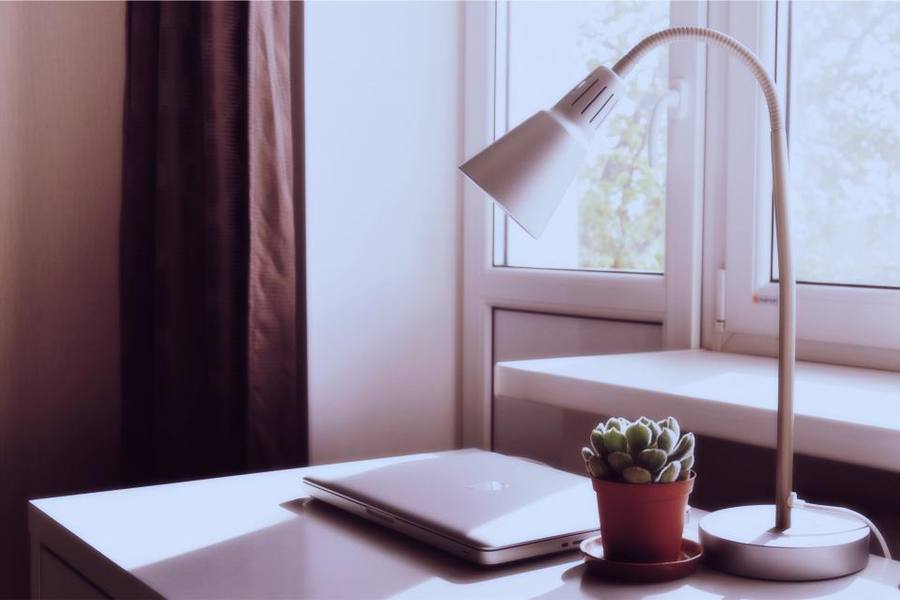
Image illustrative (photo de stock) ; ce n'est pas le produit exact.
Constant-Tension Balance
The mechanism that defines an Anglepoise is a system of springs that balances the weight of the head at any angle, so the lamp stays exactly where you move it without friction joints that eventually slacken. It was a genuine engineering innovation when it was devised and it has not been improved upon for the task.
The practical result is a lamp that can be positioned precisely and repeatedly: pulled forward over a book, pushed back and up to wash a wall, angled down onto a keyboard. Most modern LED desk lamps have one or two pivots and a fixed height, and none of them can do this.
Over years, the springs do lose some tension and can be adjusted or replaced, which is characteristic of the whole product — it is designed on the assumption that it will be maintained rather than discarded.
Standard Bulbs And Why That Matters
The Type 75 takes an ordinary screw-fit bulb rather than an integrated LED array. That single decision has consequences that only become apparent over a long time.
When an integrated LED desk lamp fails, the lamp is finished — the light source is soldered in and not replaceable, and the fixture goes in the bin regardless of how good the mechanism was. When a bulb in an Anglepoise fails, you buy a bulb.
It also means the light quality is your choice rather than the manufacturer's. Colour temperature, output and rendering are determined by which bulb you fit, and can be changed at any point if your preference or your room changes.
What It Does Not Do
There is no dimming unless you fit a dimmable bulb and a dimmer, no colour temperature adjustment beyond swapping the bulb, no ambient sensor and no app. It is a lamp with a switch.
The head also produces a more concentrated beam than a diffused LED bar, which is exactly what you want for targeted task lighting and exactly what you do not want as general desk illumination — a single Anglepoise over a desk creates a bright pool and darker surroundings.
Some people mount it on the desk edge with a clamp rather than using the base, which frees surface area and is worth considering on a small desk since the base is substantial.
Against The Alternatives
Against the Xiaomi and similar LED lamps, the Anglepoise gives up diffusion, adjustable colour temperature and app control, and gains reach, precise positioning and a replaceable light source.
Against the BenQ ScreenBar, it is the opposite product: it can be aimed anywhere and it can reflect off the screen, where the ScreenBar can do neither.
Against cheap articulated lamps with the same general shape, the difference is the spring mechanism and the build, and it is the difference between a lamp that still holds position in twenty years and one that droops in two.
Who Should Not Buy It
Anyone wanting adjustable colour temperature and dimming from the lamp itself should buy a modern LED lamp; retrofitting that here means a dimmable bulb and a compatible dimmer.
Anyone with a very small desk should consider the clamp mount, or a different lamp, because the base occupies real area.
Anyone who wants even, diffused illumination across a wide desk is better served by a light bar; this creates a pool of light by design.
The Verdict
A lamp built on the assumption that it will outlive several desks: precise spring-balanced positioning, a replaceable bulb, and parts that can be maintained rather than discarded.
It has no electronic features whatsoever, its beam is concentrated rather than diffused, and the base is large.
For targeted task lighting and for anyone who values repairability over features, it remains the reference design.
En un coup d'œil
Avantages
- Spring balance holds any position precisely and repeatably
- Standard replaceable bulb rather than a sealed LED array
- Reach and articulation far beyond modern LED desk lamps
- Built and supported on the assumption of long-term repair
Inconvénients
- No dimming, colour adjustment or sensors without a compatible bulb and dimmer
- Concentrated beam creates a pool rather than even desk lighting
- Substantial base occupies desk area unless clamp-mounted
- Springs lose some tension over many years
Questions fréquemment posées
Why choose a bulb lamp over an integrated LED?
Because when an integrated LED fails the whole lamp is scrap, however good the mechanism. A bulb lamp is re-lamped for the price of a bulb, and you choose the colour temperature and output rather than accepting the manufacturer's.
Can I dim it?
Only by fitting a dimmable bulb and using an in-line or wall dimmer. There is no dimming built into the lamp, which is the clearest functional gap against modern LED desk lamps.
Base or clamp?
The clamp frees a significant amount of desk area and positions the lamp at the edge where its reach is most useful. The base is more flexible if the lamp moves around, but on a small desk the clamp is usually the better choice.
Spécifications
| Mechanism | Constant-tension spring balance |
| Bulb | Standard screw fit, replaceable |
| Articulation | Multi-joint arm with wide reach |
| Dimming | Only via dimmable bulb and dimmer |
| Colour temperature | Determined by chosen bulb |
| Mounting | Weighted base or clamp |
| Repairability | High; springs and parts serviceable |
| Electronics | None |
Résumé
A lamp designed to outlive several desks: precise positioning, replaceable bulb, serviceable parts. No electronics at all, and it lights a pool rather than a desk.
Vérifier le prix sur Amazon